Spacetown barrier
The Caves of SteelThe Spacetown barrier is the force field the Spacers erected between their settlement and New York City, turning physical separation into a system of controlled access. It protects Spacetown from crowds and intrusion, but its apparent completeness conceals a crucial gap: the barrier blocks the direct connection, not the open country around it. That distinction moves the barrier from a symbol of political exclusion to a vulnerability in the investigation of Roj Sarton’s murder.
Establishment and Control
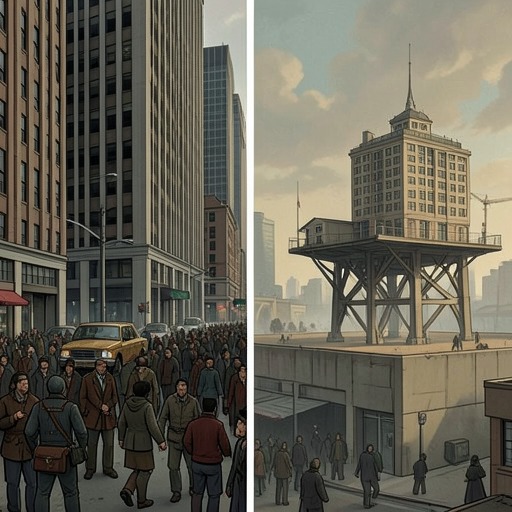
When Spacetown was established about twenty-five years before the events of the investigation, crowds from the City streamed toward it as though it were a public showplace. The Spacers ended that access politely but without compromise, raising a force barrier and instituting a combined immigration and customs service. Visitors with business had to identify themselves, submit to searches, undergo medical examinations, and accept routine disinfection. The barrier thus stood at the center of a broader admission regime: entry was possible, but only through procedures set by the Spacers.
The restrictions bred resentment and helped obstruct the City’s modernization program. The Barrier Riots made that resentment visible in the movement of bodies through the City. Baley remembered joining the mob, hanging from expressway rails, crowding into seats despite rating privileges, and running recklessly along and across the moving strips. For two days, the rioters gathered just outside the barrier, shouted slogans, and damaged City property in frustration. One chant invoked humanity’s birth on Mother Earth, setting terrestrial belonging against the Spacers’ separate, guarded enclave.
Riots and Retreat
The barrier remained intact through the riots. The Spacers did not need to deploy their offensive weapons: Earth’s obsolete fleet could not safely approach an Outer World ship, and earlier Earth planes that had crossed above Spacetown had disappeared, sometimes leaving only a shredded wing tip to fall back to Earth. The crowd, too, had reason to remember the effect of subetheric hand disruptors used against Earthmen in wars a century earlier. The barrier was not merely an obstacle at the edge of the City; it was backed by a force the rioters could not overcome.
The Spacers waited behind a barrier produced by their advanced science, one that no terrestrial method could break. City authorities eventually dispersed the mob with somno vapor and retch gas. Below-level penitentiaries filled with ringleaders and malcontents, as well as people arrested simply because they happened to be nearby; after a while, all were released. The confrontation ended not in a breach of the barrier but in the exhaustion and dispersal of the crowd.
After an interval, the Spacers eased their restrictions. They removed the barrier and entrusted the City Police with protecting Spacetown’s isolation; the medical examination, too, became less conspicuous. The shift altered the visible form of the boundary without eliminating the political concern it represented. As Baley later travels through the City, he fears that the murder investigation could reverse this relaxation: if the Spacers conclude that a terrestrial entered Spacetown and killed someone, they might raise the barrier again.
The Barrier’s Blind Spot
In conversation with R. Daneel Olivaw, Baley initially treats the barrier as the only connection between the settlements. Daneel makes the geometry concrete on paper: a large circle for New York City, a smaller one tangent to it for Spacetown, and an arrow at their point of contact labelled as the barrier. Baley sees no other connection in the sketch. Daneel agrees that the barrier is the only direct connection, then identifies what the diagram leaves open: both places are accessible from the countryside in every direction. A terrestrial could leave the City by one of its many exits and cross country to Spacetown without encountering the barrier.
That distinction revises the meaning of the boundary. The Spacers guard the entrance because they assume the barrier is where a threat will arrive. As Daneel explains, even during the Great Rebellion, the terrestrial attack concentrated on the protected entrance; nobody left the City to approach from outside. The barrier’s strength therefore coexists with a limit in the security plan: it is impenetrable at its controlled crossing, but it cannot seal off the surrounding landscape.
Significance in the Murder Investigation
Daneel connects the unguarded approach to the possibility that a terrestrial could enter Spacetown, reach a victim, kill, and leave without passing the guarded entrance. He distinguishes that possibility from a mob following the easiest route: this would be an organized small group deliberately striking at an unguarded point. The barrier, once understood as a complete defense, becomes evidence of a mistaken assumption about where danger can come from.
The prospect of restoring it also gives the murder investigation political stakes beyond identifying the killer. A renewed barrier would reimpose separation between the City and Spacetown, reversing the easing that followed the riots. Its history links mass protest, unequal control of movement, and the fragility of relations between Earth and the Spacers; its blind spot links that history directly to the case. The same structure that once kept crowds out cannot, by itself, prevent an attacker from taking a different route in.